Mar 31, 2011

Mar 28, 2011
General Training Tips
- Always warm up by walking for 3-5 minutes before your workout; end each training session with a 3-5 minute cool down, and don't forget to stretch!
- Be sure to rest from cardio for 1-2 days each week. Resting is just as important as training, because recovery will help you become more fit.
- Eat right. If you're not eating the right foods, you won't have enough fuel to complete a good workout. Learn what to eat before and after each workout to ensure you'll see results.
- Mix it up. Nothing causes fitness plateaus like monotony. Besides jogging 2-3 times per week, like this program recommends, find other ways to change up your cardio routine.
- Keep at it. If you don't continue to run regularly, you'll lose the endurance that took you weeks to build up. Run on a regular basis, aiming for 2-3 sessions each week to maintain your fitness level. Over time, try to increase your speed and distance.
- - By Jason Anderson and Nicole Nichols, Certified Fitness Professionals
The 3-Minute Step Test Scoring
http://www.sparkpeople.com/resource/fitness_articles.asp?id=1115
Scoring: Here are the age-adjusted standards based on guidelines published by YMCA.
Ratings for Men, Based on Age
Ratings for Women, Based on Age
Scoring: Here are the age-adjusted standards based on guidelines published by YMCA.
Ratings for Men, Based on Age
| 18-25 | 26-35 | 36-45 | 46-55 | 56-65 | 65+ | |
| Excellent | 50-76 | 51-76 | 49-76 | 56-82 | 60-77 | 59-81 |
| Good | 79-84 | 79-85 | 80-88 | 87-93 | 86-94 | 87-92 |
| Above Average | 88-93 | 88-94 | 92-88 | 95-101 | 97-100 | 94-102 |
| Average | 95-100 | 96-102 | 100-105 | 103-111 | 103-109 | 104-110 |
| Below Average | 102-107 | 104-110 | 108-113 | 113-119 | 111-117 | 114-118 |
| Poor | 111-119 | 114-121 | 116-124 | 121-126 | 119-128 | 121-126 |
| Very Poor | 124-157 | 126-161 | 130-163 | 131-159 | 131-154 | 130-151 |
Ratings for Women, Based on Age
| 18-25 | 26-35 | 36-45 | 46-55 | 56-65 | 65+ | |
| Excellent | 52-81 | 58-80 | 51-84 | 63-91 | 60-92 | 70-92 |
| Good | 85-93 | 85-92 | 89-96 | 95-101 | 97-103 | 96-101 |
| Above Average | 96-102 | 95-101 | 100-104 | 104-110 | 106-111 | 104-111 |
| Average | 104-110 | 104-110 | 107-112 | 113-118 | 113-118 | 116-121 |
| Below Average | 113-120 | 113-119 | 115-120 | 120-124 | 119-127 | 123-126 |
| Poor | 122-131 | 122-129 | 124-132 | 126-132 | 129-135 | 128-133 |
| Very Poor | 135-169 | 134-171 | 137-169 | 137-171 | 141-174 | 135-155 |
How to use a metronome?- The 3-Minute Step Test
A metronome is a practice tool that produces a steady pulse (or beat) to help musicians play rhythms accurately. The pulses are measured in beats-per-minute (BPM). Most metronomes are capable of playing beats from 35 to 250 BPM. Common uses of the metronome are helping you to maintain an established tempo while practicing, and learning difficult passages.
The first step in metronome use is to understand time signatures. Time signatures are found at the beginning of a musical piece, after the clef and the key signature. Time signatures (also called meter signatures) consist of two numbers. The top number indicates the number of beats in a measure, while the bottom number corresponds to the value of the beat. Most often, you will see 2, 3, 4 or 6 beats per measure. Beats are commonly half notes (the bottom number of the meter signature is “2”) or quarter notes (“4”) (the bottom number of the meter signature is “4”). Visit
Mar 26, 2011
Volleyball spiking Drills
Volleyball spiking Drills
Arm Snaps: Two athletes work together with one ball. Facing each other on the sidelines, players toss the ball up in the air with two hands and then spike the ball down into the middle of the court. They should work on a high contact point and wrist snap.
Standing Spikes: Coach tosses balls for the hitters about 10 feet back from the net. The hitter should have the hitting elbow back and up. The hitter steps to where the ball is falling and uses the hitting arm swing to hit it over the net into the court. The hitter focuses on an "elbow to wrist" contact.
Arm Swings on the Wall: Two athletes work together with one ball. One athlete stands facing the wall (about 15 feet back from it) with his/her hitting elbow up and behind his/her shoulder and the non-hitting arm up in the air. The partner is standing in front of the hitter and to the side of the hitter’s arm. The partner with the ball tosses it up in front of the hitter for him/her to spike at the wall. The hitter should be aiming at something on the wall that is about net height.
Box Spiking: Perhaps the most important of all spiking volleyball drills are the ones that involve spiking on a box. Players should spike on a box every practice. When on a box, players should focus on the contacting the ball high, with arm vertical, and contacting in such a manner that makes the ball spin (topspin).
Mar 22, 2011
Zaireey@Pendidikan Jasmani Dan Sains Sukan: Anuar
Zaireey@Pendidikan Jasmani Dan Sains Sukan: Anuar: "Anuar Manan Name:Anuar Family name:Manan Nationality:Malaysia Gender: Age:24 years Date of birth:11-10-1986 Place of birth:Kuala Ibai, Tren..."
Mar 18, 2011
Muscular Strength, Power, and Endurance
In practical evaluations muscular function, the force-generating characteristics of muscle are discussed within the concepts of muscular strength, power, and endurance. These characteristics of muscle function have significant implications for success in different forms of strenuous physical activity.
(a) Muscular Strength
Muscular strength is derived both from the amount of tension the muscles can generate and from the moment arms of the contributing muscles with respect to the joint centre. The tension-generating capability of a muscle is related to its cross-sectional area and its training state.
(b) Muscular Power
Muscular power is the product of muscular force and the velocity of muscle shortening. Maximum power occurs at approximately one-third of maximum velocity and at approximately one-third of maximum
concentric force. Muscular power is an important contributor to activities requiring both strength and speed.
(c) Muscular Endurance
Muscular endurance is the ability of the muscle to exert tension over time. The longer the time tension exerted, then greater the endurance.
(d) Muscle Fatigue
Muscle fatigue has been defined as an exercise-induced reduction in the maximal force capacity of muscle. Fatigability is also the opposite of endurance. The more rapidly a muscle fatigues, the less endurance it has.
Factors Affecting Muscular Force Generation
Factors Affecting Muscular Force Generation
The magnitude of the force generated by muscle is also related to the velocity
of muscle shortening, the length of the muscle when it is stimulated, and the
period of time since the muscle received a stimulus. Because these factors
are significant determiners of muscle force.
(a) Force-Velocity Relationship
The maximal force that a muscle can develop is governed by the
velocity of the muscle’s shortening or lengthening.
(b) Length-Tension Relationship
The amount of maximum isometric tension a muscle is capable of
producing is partly dependent on the muscle’s length. In single muscle
fibers, isolated muscle preparations, and in vivo human muscles, force
generation is at its peak when the muscle is slightly stretched.
Conversely, muscle tension development capability is less following
muscle shortening. Both the duration of muscle stretch or shortening
and the time since stretch or shortening affect force generation
capability.
(c) Electromechanical Delay
When a muscle is stimulated, a brief period elapse before the muscle
begins to develop tension and is referred to as electromechanical
delay(EMD), this time is believed to be needed for the contractile
component of the muscle to stretch the series elastic component(SEC).
During this time, muscle laxity is eliminated. Once the SEC is
sufficiently stretched, tension development proceeds.
Extensibility and Elasticity
Extensibility is the ability to be stretched or increase in length, and
elasticity is the ability to return to normal length after a stretch. Muscle’s
elasticity returns it to normal resting length following a stretch and
provides for the smooth transmission of tension from muscle to bone.
Irritability and the Ability to Develop Tension
Irritability is the ability to respond to a stimulus. Stimuli affecting
muscles are either electrochemical, such as an action potential from the
attaching nerve or mechanical, such as an external blow to a portion of
a muscle. When activated by a stimulus, muscle responds by
developing tension.
elasticity is the ability to return to normal length after a stretch. Muscle’s
elasticity returns it to normal resting length following a stretch and
provides for the smooth transmission of tension from muscle to bone.
Irritability and the Ability to Develop Tension
Irritability is the ability to respond to a stimulus. Stimuli affecting
muscles are either electrochemical, such as an action potential from the
attaching nerve or mechanical, such as an external blow to a portion of
a muscle. When activated by a stimulus, muscle responds by
developing tension.
Mar 17, 2011
Yo-Yo Endurance Test
The Yo-Yo Endurance Test (continuous) is a variation of the beep test. There are two versions of this test: Level 1 & 2 (a beginners and advanced level). The level one test is effectively the same as the standard beep test. The Level 2 test starts at a higher running speed and has different increments in speed (see Yo-Yo Endurance Test Levels). There is also an intermittent version of the Yo-Yo test, which incorporates a recovery period after each 40m (2x20m) run.
- purpose: The test evaluates an individual's aerobic endurance fitness.
- equipment required: Flat, non-slip surface, marking cones, measuring tape, pre-recorded audio cd or mp3 (buy or make your own), cd player, recording sheets.
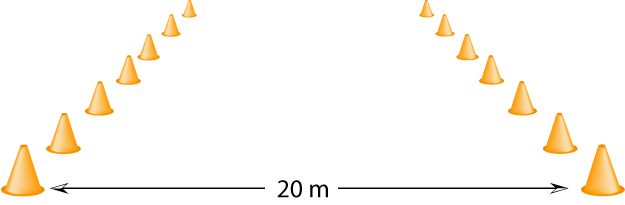
- procedure: Use cones to mark out two lines 20 meters apart as per the diagram. The subjects start with their foot behind one of the lines, and begin running when instructed. They continue running between the two lines, turning when signaled by the recorded beeps. After each minute or so, the pace gets quicker. If the line is not reached in time the subject must run to the line turn and try to catch up with the pace within 2 more ‘beeps’. The test is stopped if the subject fails to catch up with the pace within the two ends.
- variations: There are two versions of this test: Level 1 & 2. The level one test is effectively the same as the standard beep test. The Level 2 test starts at a higher running speed and has different increments in speed. See Yo-Yo Endurance Test levels. See also about Beep Test variations.
- scoring: The athlete's score is the total distance covered before they were unable to keep up with the recording. The Yo-Yo intermittent test usually takes between 6-20 minutes for level 1 and between 2-10 minutes for level 2. See some Yo Yo Test Results.
- target population: This test is suitable for sports teams and school groups, but not for populations in which a maximal exercise test would be contraindicated. It is commonly performed by soccer players.
- reliability: Reliability would depend on how strictly the test is run, and the previous practice allowed for the subjects.
- advantages: Large groups can perform this test all at once for minimal costs.
- disadvantages: Practice and motivation levels can influence the score attained, and the scoring of when a person is out of the test can be subjective. As the test is usually conducted outside, the environmental conditions can also affect the results. The test cd must be purchased.
- other considerations: This test is a maximal test, which requires a reasonable level of fitness. It is not recommended for recreational athletes or people with health problems, injuries or low fitness levels. You may not have power where you want to conduct this test. If so, you need to ensure that the batteries of the audio player are fully charged.
- comments: This test was developed by the Danish soccer physiologist Jens Bangsbo and his colleagues.
Subscribe to:
Posts (Atom)

